Last month, twenty Diné farmers from Shiprock, New Mexico headed to D.C. to advocate for Indigenous food sovereignty.

Situated along the perennial San Juan River, a community of Diné farmers in Shiprock, New Mexico draws water from the river for irrigation. The Toohnii Binaneestˀąˀ Ałtaasˀéí Alliance (ToohBAA) is an Indigenous woman-led Diné farmers’ collective incorporated under the Navajo Nation Corporation Code. Toohnii –“water edge people”, Binaneestˀąˀ – “their farm produce”, Ałtaasˀéí – “myriad of”; or, the myriad variety of farm produce grown by the river edge people. The acronym ToohBAA is a powerful term in itself, meaning “water edge”.
Collectively, they farm 250 acres of land worked by member farmers primarily within the Shiprock community area. Though there are over 12,000 acres of irrigable farmlands held among six Diné communities along the river, less than 20% of these acres are currently actively farmed.
For these farmers, their overarching vision is to achieve true food sovereignty – to reinvigorate and reinforce the resilient capacity to feed themselves and multiple generations to come. They focus on reinstituting ancestral food systems concepts, merged with modern day farming practices, to help the families within the six communities revitalize their farms. ToohBAA’s mission is to provide healthy produce and value-added products to Navajo communities, other Indigenous Nations, the State of New Mexico, and the Four Corners region.
Last month, a group of twenty ToohBAA farmers, ranging from an aspiring teenage farmer to seasoned tribal elders traveled to DC to meet with Congress and advocate for a federal farm bill that supports Indigenous food sovereignty, small farms, and regenerative agriculture.
If you want to be sovereign, act sovereign. – Vine Deloria Jr, author and Indigenous activist
Food sovereignty as a modern-day movement was popularized by La Via Campesina in 1996, though it is deeply rooted in millennia of Indigenous farming practices and food systems. Particularly following the reclamation of Indigenous self-determination in the US in the latter half of the 20th century, there was a rising awareness that the foods popularized and imposed by colonizing nations were not healthful for Indigenous communities or the land. Indigenous food sovereignty can be practiced in a variety of ways, but generally aims to create opportunities for communities to produce culturally relevant foods within localized production and distribution systems. ToohBAA operates programs to achieve food sovereignty, with government funded farm to table programs, local food sales to youth mentorship to a seed bank, to regenerative farming and retention of cultural knowledge.
In August 2015, an abandoned mine in southern Colorado was breached by the Environmental Protection Agency (EPA). Toxic waste waters flooded into the Animas watershed, contaminating waterways in parts of the Four Corner states, including the San Juan River. The Gold King Mine environmental disaster was traumatic for the Shiprock community – during the height of their growing season, they had to shut off irrigation waters, losing 75% of their total crops. Due to the EPA’s role in causing the disaster and further mishandling, farmers continued to question the safety of the waters and were cautious about resuming irrigation. Ultimately, despite the detrimental effects of the spill which severely impacted roughly 2,000 Diné people and farmers, the US government offered only $150,000 in compensation.
For a community working towards food sovereignty, with a deep cultural and spiritual connection to the land and water, the Gold King Mine disaster was a traumatic reminder of the challenges farmers face as they seek to grow Indigenous foods using traditional practices. From a general lack of resources and support to explicit barriers to conventional agriculture resource programs, the effort to achieve food sovereignty can compel tensions to declare sovereignty. As one of the group’s leaders, Chili Yazzie, told USDA officials, “I am one advocate that refuses to accept the notion that this is federal land. My position is that it is our land – our Indigenous land. We need to realign ourselves. We are emphasizing our culture – the culture that is the center point of the many teachings of our Indigenous ways, the values and principles that sustained our peoples for millennia.” He quoted the words of Vine Deloria, Indigenous activist: “If you want to be sovereign, act sovereign.”

FSA Administrator Zack Ducheneaux and young farmer Graham Beyale 
Walking the hall of Hart Senate building after meeting with Senator Corey Booker 
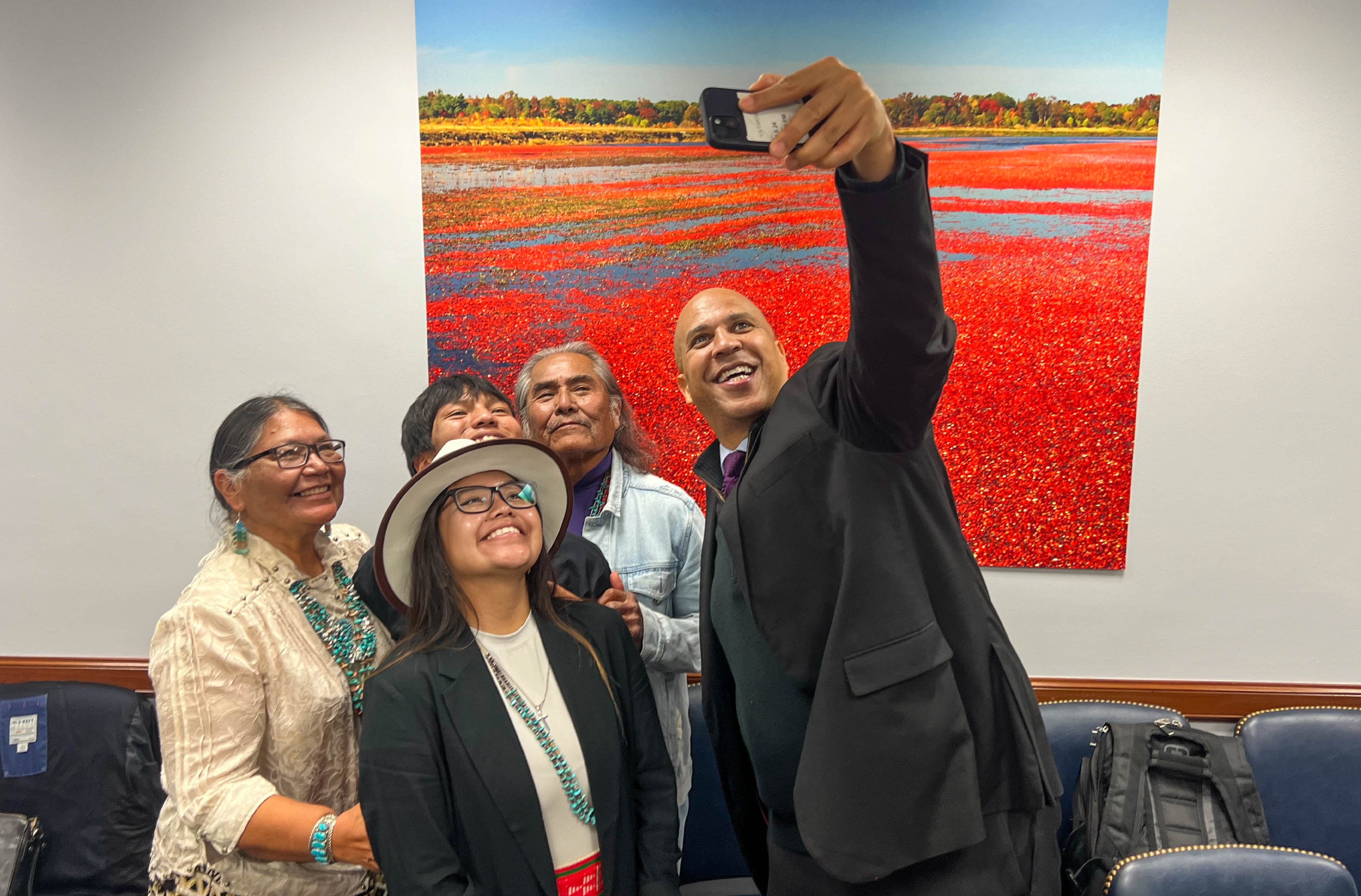
An infamous Senator Booker selfie 
Farmers meet with Secretary of the Interior Deb Haaland 
New Mexico Senator Martin Heinrich greets young Diné farmers 
Undersecretary Xotchil Torres Small with Chili Yazzie and FSA Adminstrator Zach Ducheneaux
The ToohBAA farmers’ advocacy made an impact on the Hill and in the meetings with high-level federal officials–including USDA Deputy Secretary Xochitl Torres Small and FSA Administrator Zach Ducheneax; Secretary of Interior Deb Haaland; several members of Congress including Senators Ben R Lujan, Martin Heinrich, Cory Booker and Representatives Felicia Leger Fernandez and Jim Baird; and key House and Senate Agriculture Committee staff.
The farmers shared how their practices are values-based, utilizing Traditional Ecological Knowledge, and how they are bringing back Indigenous farming knowledge as America’s first agriculturists and environmentalists.They advocated for the strengthening of and greater access to federal agriculture programs to provide more support for Indigenous, small and regenerative farmers, rather than continuing to bolster big agriculture. Their asks included education, equipment, and capital resources as well as the inclusion of these policy concerns into the new Farm Bill:
- Help ending hunger in Indigenous communities, and support for Indigenous efforts to achieve food sovereignty
- Ensuring equity in all USDA and relevant agencies’ policies
- Setting aside funds and resource support for Indigenous farmers as a matter of Treaty obligation to increase access to federal resources
- Ensuring there is Indigenous representation on policy and administrative components of the USDA and related federal agriculture programs
- Providing adequate resources to facilitate a resounding impact on regenerative agriculture across America
- Guaranteeing USDA and all federal agencies are helping combat the climate crisis
- Ensuring the safety and dignity for farm and ranching families and workers
With the right support in the Farm Bill and from the USDA for regenerative agriculture, and equity and access to federal programs for Indigenous farmers, ToohBAA farmers could farm significantly more land, helping feed their people and becoming closer to achieving food sovereignty while also increasing their resilience to a changing climate both now and in the future.
In the meeting with Senator Booker, he asked one of the young farmers what makes their kind of farming different from conventional and industrial farming. She thoughtfully replied,”For us, Earth Mother is always first. As native peoples, we are connected to our Earth Mother. That is how our farming is different.”
The Toohnii Binaneestˀąˀ Ałtaasˀéí Alliance (ToohBAA) fly-in was supported by the Windward Fund. It was coordinated by InCommon Group, in partnership with Chili Yazzie and ToohBAA members.