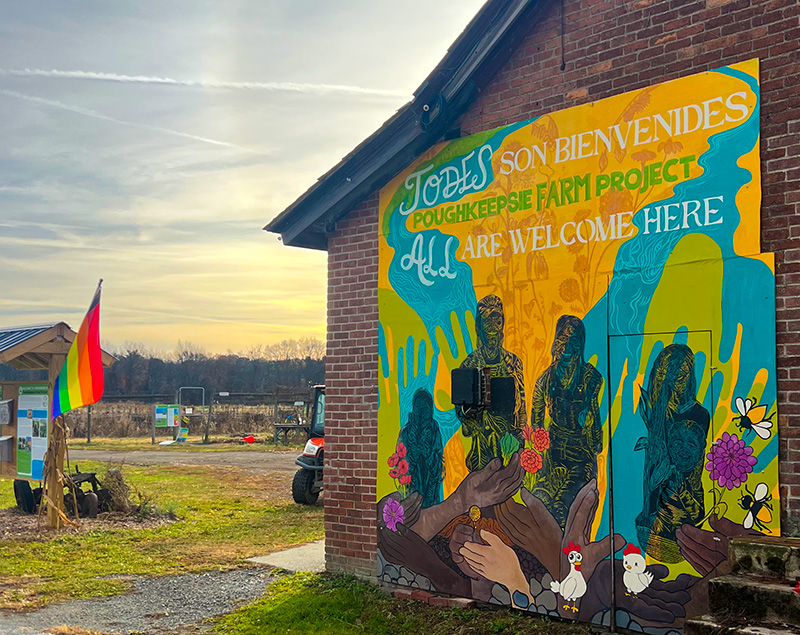
Notes and reflections on the need for democracy, community, and place-based power, based on recent client work. The above photo of the Poughkeepsie Farm project office building was taken while on-site for a strategic planning retreat.
As more people recognize that agriculture and food systems are a cornerstone for human, community, and planetary health, meaningful solutions are rising to the surface. Soil health, local food, preventive health, resilient supply chains—these ideas are no longer fringe. However, one of the most powerful solutions available to us is one of the most consistently overlooked and least resourced: participatory, community-based food & farming groups that are already doing the work of regeneration on the ground.
Across the country, these organizations are practicing context-specific regeneration; providing a pathway for participation and connection across people, sectors, land, and local economies; and creating the conditions for what can be described as food sovereignty.
Food sovereignty, as defined in the 2007 Declaration of Nyéléni, is “the right of peoples to healthy and culturally appropriate food produced through ecologically sound and sustainable methods, and their right to define their own food and agricultural systems.” Crucially, this definition places the needs and aspirations of those who produce, distribute, and consume food at the center of policy, rather than the demands of markets and corporations.

We have also written about regenerative economics recently. In the framework, long term economic health stems from maintaining robust and equitable circulation/exchange, diversity, learning, and mutual benefit across people, land/water, and institutions.
And while the regenerative economic framework has less of a focus on decision-making and power dynamics, there are many ways that the food sovereignty and regenerative economic frameworks are deeply aligned. Both understand food systems as complex, living systems that center relationships, equity, and mutuality. And both insist that regeneration is not a technical fix, but a highly contextual, place-based relationship to the land and each other.
- They are typically small (and chronically underresourced) yet able to carry out transformative work
- They are rooted in community need, not extractive models of profit
- They all center justice, equity, health, and ecosystems
- They build community power and foster participatory engagement
- They see themselves as part of an interconnected and interdependent system that works and learns together

Whether it is farmers and food entrepreneurs navigating fragile infrastructure in rural Maine, working lands businesses in Vermont seeking equitable access to capital, or place-based community farms like Poughkeepsie Farm Project weaving together sustainable stewardship, food distribution, education, and justice, the pattern is consistent: regeneration emerges when people in communities have agency, and when there is accountability to one another.
This is also increasingly visible at the nexus of food and health care systems. Through our work with Food is Medicine practitioners, we see hospitals and health systems beginning to treat food as preventive health infrastructure. When health care institutions work directly with farms and community partners, they improve patient outcomes while reinforcing the economic and ecological foundations of health itself.
Yet at this same moment, the language of “health” and “regeneration” is being pulled into US politics and movements that are simultaneously undermining democracy, public health, and human rights—particularly impacting immigrants, workers, and our most vulnerable. This tension exposes a clear truth: there is no such thing as regeneration without democracy, justice, and care.
We believe regenerative food systems depend on empowered participation, and that food sovereignty must be a central premise of regeneration. There is no regeneration in systems where farmers struggle to make a living, workers are disposable, immigrants are criminalized, people struggle to put healthy food on the table, or communities are excluded from decisions about their own food and land.
We often talk about the need for scale and sweeping change, and that is real. Federal and state policy shifts are urgently needed—but largely to stop incentivizing consolidation, exploitation, and extraction, and to start amplifying systems that nourish, circulate, and create connections.
This change begins and ends within our communities. As more Americans express a desire to take charge of their health, the solution is not to moralize food or restrict rights. It is to support and replicate the work of farming and community-based organizations and networks that are already building food sovereignty—quietly, persistently, regeneratively.